
Understanding Colour Harmony & the 16‑Subseason System: Why the Most Accurate Colour Analysis Is Always In‑Person
Colour analysis is often misunderstood as simply “finding your undertone”. But true colour harmony is far more intricate — a beautiful interplay of undertone, depth, chroma, and contrast all working together to reveal the colours that support you most.
This is why the 16‑subseason system is the most accurate and nuanced approach. It honours the subtle shifts in your natural colouring — the tiny details that make you you — and creates a palette that feels harmonious, effortless and deeply personal.
Let’s explore how it works.
What Colour Harmony Really Means
Colour harmony is the moment when the colours you wear feel like an extension of you. Your skin looks clearer. Your eyes brighten. Your features lift. You look rested, confident and naturally radiant.
Harmony happens when your palette mirrors your natural colouring — not just your undertone, but the full picture of who you are.
Why Undertone Alone Isn’t Enough
Undertone is important, but it’s only one thread in the tapestry.
Your undertone is determined by your genetic pigment blend — the ratio of eumelanin (brown/black pigment) and pheomelanin (red/yellow pigment) you were born with. This is why undertone never changes, even when your surface tone does.
But undertone alone cannot place you in a season. Two people with the same undertone can belong to completely different palettes.
The Four Pillars of Colour Harmony
To understand your palette fully, we look at four key elements — each one distinct, each one essential. Please see previous blog posts to learn more about each one.
1. Undertone
The temperature of your colouring — warm, cool, neutral leaning warm or neutral leaning cool.
2. Depth
How light or dark your natural colouring is.
3. Chroma
How soft or clear your colouring appears.
4. Contrast
How your features relate to one another — the pattern your colouring creates.
Each pillar tells a different part of your colour story. Together, they create your most accurate palette.
Why the 16‑Subseason System Is the Most Accurate
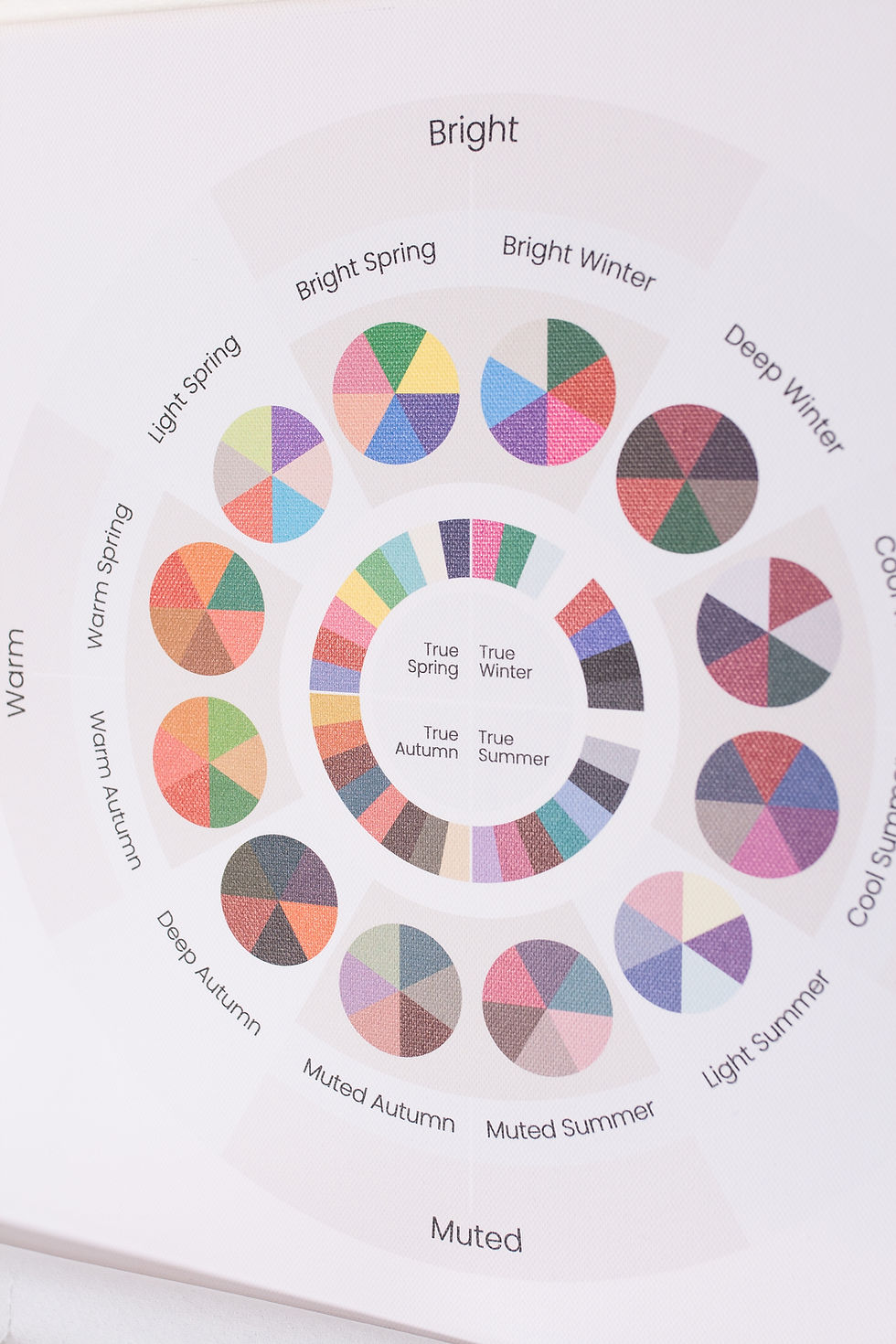
The traditional 4‑season system (Spring, Summer, Autumn, Winter) is beautiful — but broad. It doesn’t account for the subtle variations that make each person unique. If your undertone is neutral leaning you can have a sister palette in a different season that will also work for you. For example if you were previously matched as summer but it feels a little off - you could be a muted summer that also has a sister palette of muted autumn. This is why we look at more than just undertone to help personalise your palette.
The 16‑subseason system refines each season into four nuanced categories, allowing for:
softer vs clearer versions
lighter vs deeper versions
warmer vs cooler variations
balanced vs high‑contrast combinations
This means your palette is not just “Summer” or “Autumn” — it’s the exact expression of your colouring.
Examples:
True Summer, Light Summer, Cool Summer, Muted Summer
True Autumn , Deep Autumn, Warm Autumn, Muted Autumn
True Winter, Bright Winter, Deep Winter, Cool Winter
True Spring, Warm Spring, Light Spring, Bright Spring
These distinctions matter. They are the difference between “this almost works” and “this feels like me”.
How the 16‑Subseason System Creates True Harmony
Because it considers all four pillars, the 16‑subseason method allows for:
subtle shifts in undertone
delicate variations in chroma
precise depth matching
accurate contrast alignment
palettes that feel natural, not forced
colours that support your features instead of competing with them
It’s the most personalised, refined approach — and the one that consistently gives women the “oh… that’s me” moment.
Why You Need a Specialist for Accurate Colour Analysis
Colour analysis is both an art and a science. It requires specialist training to:
read the skin’s micro‑reactions
distinguish surface tone from undertone
assess chroma without confusing it with depth
understand how contrast shapes colour combinations
interpret how all four pillars interact
place someone accurately within the 16‑subseason system
This cannot be done accurately through photos, filters or online quizzes. Lighting, cameras and screens distort colour too dramatically.
Why In‑Person Colour Analysis Is Always Best
In person, I can see in real time:
how your skin responds to different temperatures
whether your eyes brighten or dull
how your features shift with soft vs clear colours
whether deeper shades overwhelm or flatter
how your natural contrast behaves
the subtle interplay between all four pillars
These micro‑changes are impossible to judge online, in my opinion. This is why in‑person colour analysis remains the gold standard — and why your results feel so accurate, so personal, and so deeply affirming.
A Gentle Invitation
If you’ve been feeling unsure, overwhelmed or stuck with your wardrobe, the 16‑subseason system offers clarity, confidence and calm. It shows you the colours that feel like home — the ones that honour your natural beauty and make getting dressed feel effortless.
Colour Analysis appointments are open now


Comments